Measuring What Matters: How the Global Destination Sustainability-Index Can Help Shape the Future of Banff and Lake Louise
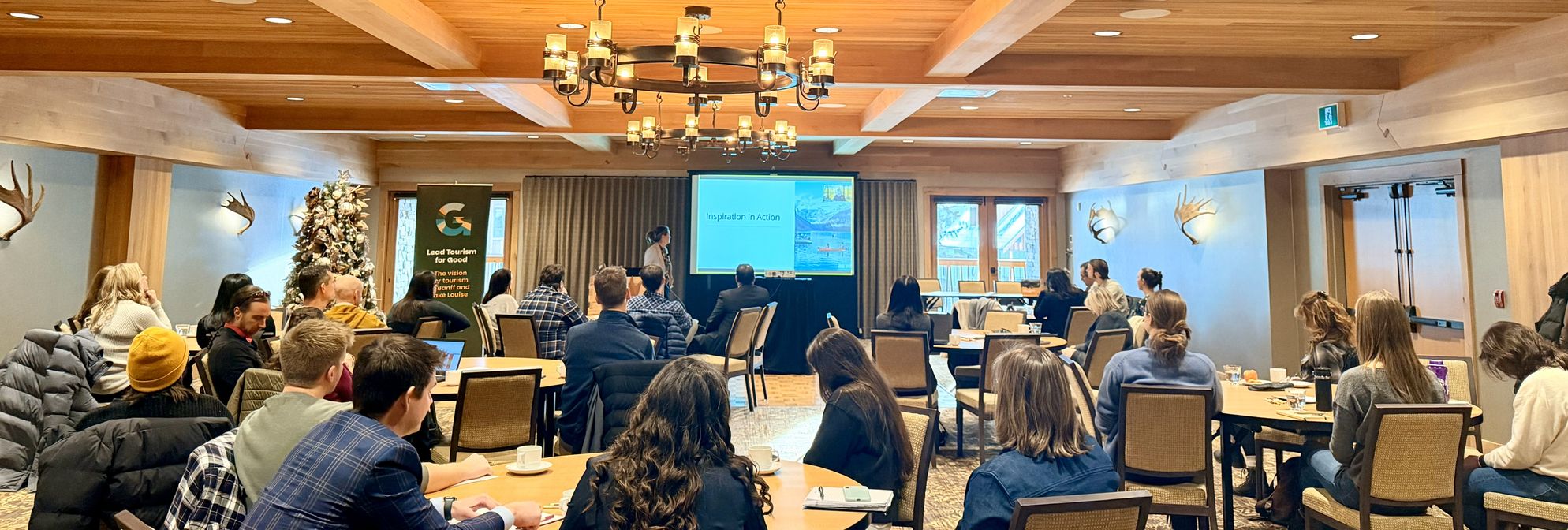
How can Banff and Lake Louise measure what truly matters for long-term community wellbeing, environmental health, and a thriving visitor economy? That question guided the latest Lead Tourism for Good Speaker Series, where tourism partners and community members gathered for an interactive workshop led by Alexis Kereluk from Connect7 Group and Guy Bigwood, CEO and Chief Changemaker of the Global Destination Sustainability Movement.
The session outlined why Banff and Lake Louise has adopted this globally recognized sustainability benchmarking tool—and what it means for the future of the destination. Through presentations, case studies, and group exercises, the workshop highlighted the opportunity ahead: to build a smarter, more resilient, and more regenerative visitor economy. To Lead Tourism for Good.
Here are four key things we learned:
The Global Destination Sustainability-Index helps us see the complete picture
Tourism’s value in Banff and Lake Louise is significant, but much of it goes unmeasured. Beyond economic impact, the GDS-Index helps quantify how tourism contributes to community wellbeing, housing, education, and environmental stewardship.
During the workshop, Guy Bigwood emphasized what makes the tool different: “The Index is not a certification — and that’s deliberate. Destinations need something fast-moving, something focused on innovation and continuous improvement.”
Recent local accomplishments—support for community groups, investments in sustainability, and ongoing work by businesses and nonprofits—are now being captured more consistently. The tool brings these stories together, creating a shared understanding of tourism’s broader benefits and opportunities.
In other words: the index helps us measure what matters, not just what’s easy to count.
Preparing for 2050 means planning for uncertainty, and managing risk now
Participants were invited to imagine Banff and Lake Louise in 2050. The scenario underscored a central theme: the future is full of variables we can’t control—climate impacts, labour shortages, economic volatility, shifting visitor expectations, and rapid technological change.
The GDS-Index plays a key role in “de-risking” tourism by creating a structured approach to understanding vulnerabilities and building resilience. It highlights gaps and identifies opportunities. From climate action to visitor management to community sentiment, the index provides indicators that help anticipate challenges before they become crises.
Alexis shared: “Strategic tools help us ensure we end up closer to the future we want—not the future that happens by default.”
The Index is not a certification — and that’s deliberate. Destinations need something fast-moving, something focused on innovation and continuous improvement.
Guy Bigwood, CEO and Chief Changemaker of the Global Destination Sustainability Movement
Banff and Lake Louise is improving but has room to grow
This year’s results show an improvement over last year, driven largely by stronger environmental performance. It’s a promising leap that reflects growing alignment with the destination’s vision to Lead Tourism for Good.
Town of Banff’s Manager of Sustainability, Michael Hay, presented at the workshop and shared key actions the municipality is taking that are helping drive the destination’s score upward. This includes the adoption of an Environmental Master Plan, which guides major sustainability priorities such as renewable energy, waste diversion, sustainable transportation, and other initiatives that strengthen the long-term health of the community and the park.
Compared to other North American destinations, Banff and Lake Louise performs close to average, and similar-sized communities tend to score higher in DMO-related categories. That means there is meaningful opportunity ahead—particularly in areas like measurement, certification, and coordinated strategy.
The takeaway? We’re progressing quickly, but collective action can accelerate that momentum.
Global inspiration points to the path forward
The workshop showcased case studies from around the world—Sydney’s Sustainable Destination Partnership, Quebec City’s climate roadmap, Singapore’s capacity-building programs, and Helsinki’s tailored sustainability communications.
Each example illustrated that success requires shared ownership: collaboration between businesses, government, residents, and the Destination Marketing Organization.
Participants were then invited to reflect on what they see happening here in Banff and Lake Louise in sustainable tourism: Where are we excelling? Where can we improve? Who needs to be part of the solution?
The message was clear: everyone has a role in shaping a thriving, regenerative future.
As Banff and Lake Louise advances its work with the GDS-Index, the commitment to leading Tourism for Good grows stronger. Together, by measuring what matters, engaging partners, and embracing innovation, we can build a destination that remains extraordinary—for people and park, for better and forever.
The next Lead Tourism for Good Speaker Series will be in 2026! Follow @leadtourismforgood on social media to stay updated on future events.